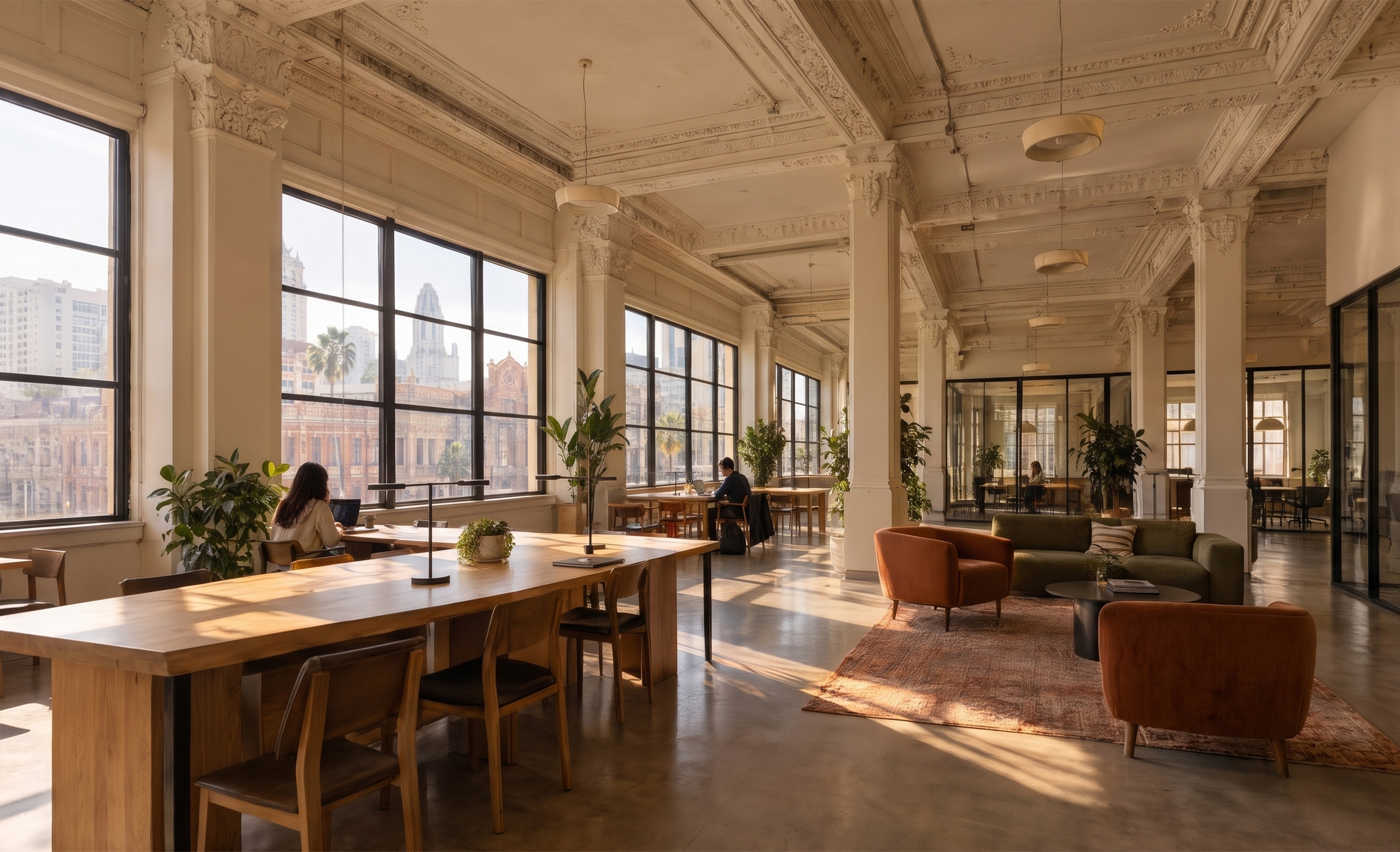
Illustrative image: an impression of a coworking space in downtown Los Angeles. AI-generated.
On 2 November, a Dutch flexible workspace operator will open the doors of a 1920s department store in Downtown Los Angeles and welcome its first American members. Amsterdam-based infinitSpace is launching beyond Broadway DTLA in the historic Desmond’s Building at 612 South Broadway. It doesn’t plan to stop there: the company wants to open 30 locations across the United States within the next two years.
That is a bold leap for an operator founded only in 2020 that runs a little over a dozen sites in Europe and the Middle East. The way infinitSpace is crossing the Atlantic also says a lot about where the flex industry is heading.
A first site with a coworking past
The LA workspace covers roughly 2,970 sqm (32,000 sq ft) across floors two to five of the Desmond’s Building, with room for around 400 members. It will have the familiar mix of private offices, shared desks, meeting rooms and lounges, plus a rooftop event space. An option on the sixth floor could add another 790 sqm later.
The building wasn’t picked at random. It previously housed a coworking operation, so the fit-out is largely in place and infinitSpace can open without a major renovation. For a newcomer in a foreign market, that matters. Upfront costs are lower, revenue arrives sooner, and there is less exposure if the first months are slow.
Demand also shaped the choice of city. According to CEO Wybo Wijnbergen, existing members asked for a Los Angeles presence. That pushed LA to the front of a list that already included San Francisco, Austin, Seattle and New York. “Los Angeles is the right place to begin,” he said in the announcement.
The model infinitSpace is exporting
The most interesting part of this expansion is the contract, not the address. infinitSpace doesn’t sign traditional master leases. It works under management agreements instead. The property owner keeps ownership and control of the building, while infinitSpace designs, runs and markets the workspace. That can happen under the landlord’s own brand (white label) or under infinitSpace’s premium beyond brand. In Los Angeles, the agreement runs for 15 years.
This approach has quietly become one of the main growth routes in European flex. infinitSpace already works with landlords such as Brookfield and Patrizia. It recently opened in Munich in partnership with Bayerische Hausbau, and it is the operating partner for The Stack, Amsterdam’s hub for AI companies. The US move tests whether the same pitch works with American property owners.
There are good reasons to think it might. Office vacancy in Downtown LA has been climbing, and owners of older, characterful buildings face a choice. They can wait for a conventional tenant who may never come, or they can turn the space into something people actually want to use. A management partner gives them a share of the upside without having to build an operating business themselves. The operator, in turn, ties up far less capital in long leases, which is exactly the liability that brought down many flex players over the past decade.
Wijnbergen knows that history well. Before founding infinitSpace with his brother Wilco, he was a managing director for Europe at WeWork. The company’s structure reads like a direct answer to the lease-heavy model that once nearly broke the industry’s biggest name.
A crowded market and an ambitious timeline
Los Angeles is hardly an empty field. It has more coworking locations than any other US city, around 349 centres, and coworking supply across the country keeps growing quarter after quarter. infinitSpace won’t win on novelty alone.
It is betting on three things:
- Technology: The company runs an in-house platform that uses AI to automate administrative work. That matters a great deal when you’re trying to launch 30 sites with a lean team.
- Local experience: It hired Andrea Pirrotti-Dranchak as head of real estate for the Americas. She is a US flex veteran who previously worked at Regus, Office Evolution, NewFlex and Expansive.
- Network: Members can use locations across the international portfolio, which appeals to companies with teams on both sides of the Atlantic.
The pipeline is already taking shape. Reported projects include roughly 2,790 sqm in San Francisco’s Financial District, about 4,180 sqm in Austin’s central business district, and some 3,250 sqm in Manhattan between Madison and Fifth Avenues.
Still, 30 openings in 24 months is a pace few operators sustain, even in their home market. Every new city brings new landlords, regulations, staff and member expectations. The management-agreement model lowers financial risk, but it doesn’t remove execution risk. Landlords who sign up will expect occupancy to follow quickly.
Why this matters for the Dutch market
For readers in the Netherlands, there is a bigger story here. Dutch flex concepts have travelled before: Spaces started in Amsterdam before IWG took it worldwide. A young, independent Dutch operator building its own US network is much rarer. infinitSpace is taking a European-style partnership model to the country where the coworking boom began.
If it works, more landlords on both sides of the Atlantic will start asking why they should sign away a long lease when they could keep the building and share the revenue. More Dutch operators may also look beyond national borders sooner than they had planned.
Worth watching
infinitSpace’s LA opening is a single building, but it is also a proof of concept. The first months on Broadway will show whether American landlords and members embrace a Dutch-run, asset-light operator. They will also show whether 30 US sites is a realistic plan or an aspiration.