Spain’s flexible workspace market keeps finding new corners to grow into, and the latest mover is OneCoWork. The Barcelona-born operator has just confirmed two new sites: one in Madrid, one in Málaga, alongside a previously announced Barcelona opening still in the pipeline. Once all three are live, OneCoWork’s network will stand at seven locations across Spain and the UK.
It’s a modest number next to the giants of the flex world, but the expansion says a lot about where Spain’s coworking demand is heading: beyond Madrid and Barcelona, and into secondary cities with their own growing professional and tech scenes.
Rooftop terraces and sea views: Say hello to Piamonte and Pacífico
The Madrid site, named Piamonte, takes up roughly 2,300 square metres across four floors in the city centre. It’s built around the now-familiar flex-office formula: private offices, a mix of fixed and flexible desks, meeting rooms, and a rooftop terrace overlooking the city. It becomes OneCoWork’s second site in the Spanish capital, following its first Madrid campus which opened in 2025 and has reportedly been running close to full occupancy ever since.
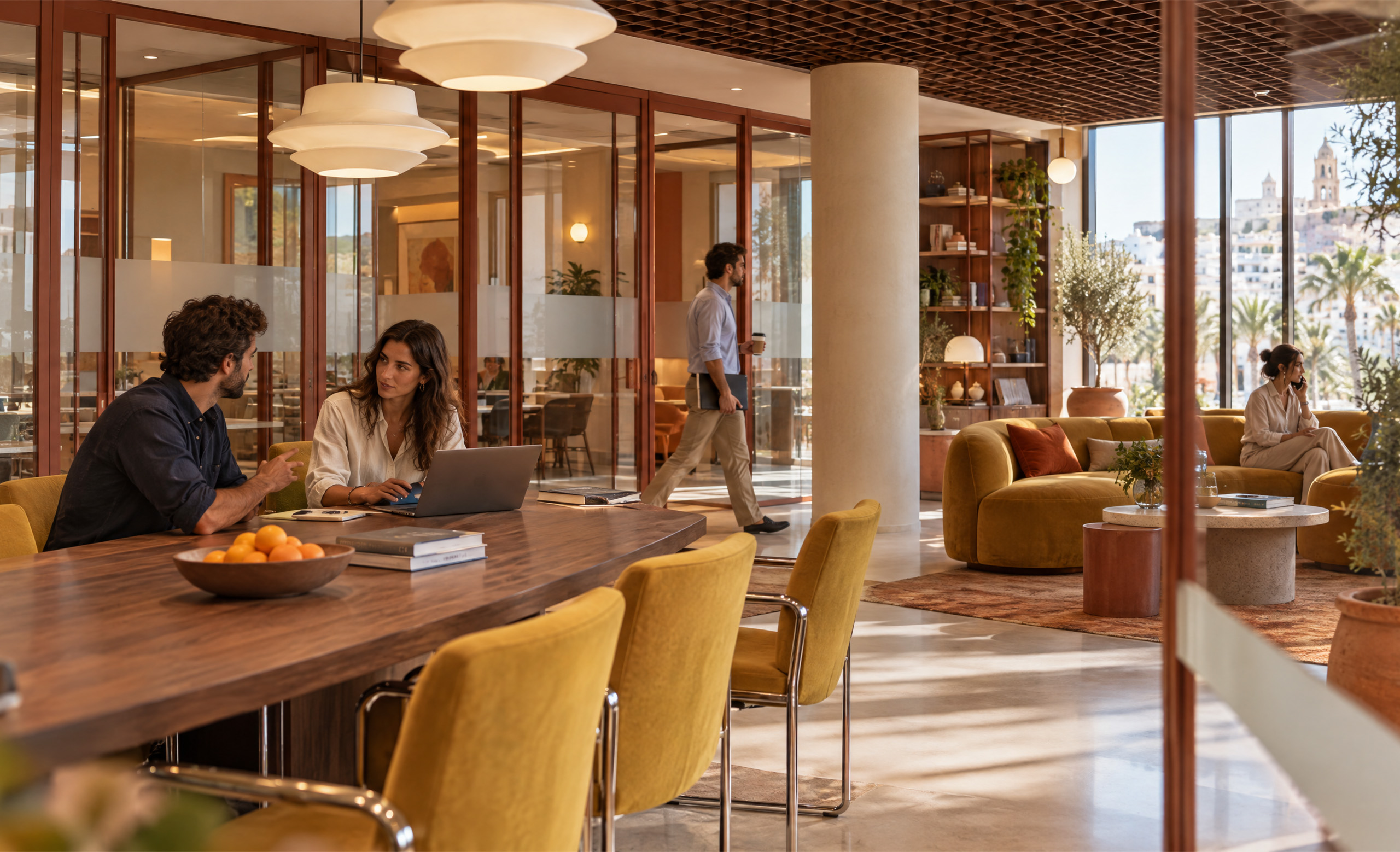
Málaga, meanwhile, is new territory entirely. The site, called Pacífico, is scheduled to open in December 2026 on the seafront, near Málaga’s “Polo Digital” tech cluster. At just over 2,200 square metres spread across two floors, it will include private offices, open coworking space, two outdoor terraces, and a 100 square-metre rooftop with sea views, plus parking and easy links to the airport, city centre and high-speed rail.
Both openings follow a 2,650 square-metre site that opened in Barcelona earlier this year, alongside a reshuffle of the brand’s original Barcelona portfolio: its former Plaça Catalunya location has closed, with operations consolidated into nearby central branches. Once the dust settles, OneCoWork’s footprint will read: three sites in Barcelona, two in Madrid, one in Málaga, and one in Preston, in the UK.
Why everyone suddenly wants a desk in Málaga
Málaga has quietly become one of the more interesting flex-office stories in southern Europe over the past few years. What used to be a sun-and-retirement city has built up a genuine tech and startup cluster, helped along by initiatives like the Polo Digital campus and a steady stream of remote workers and relocating companies drawn by the lifestyle and lower costs relative to Madrid or Barcelona. Flex operators have taken notice, and OneCoWork’s arrival adds another credible name to a city that, until recently, wasn’t on most coworking maps.
It also reflects a broader pattern across the flexible workspace industry this year: operators are increasingly looking past the usual capital-city playbook and betting on Spain’s secondary and coastal cities, where corporate demand for professional, well-equipped space is growing faster than the premium office stock available to meet it.
One landlord, three brands, one grand plan
OneCoWork isn’t expanding in isolation. Its majority owner is Agartha Group, a Spanish real estate investment firm that has been quietly assembling a multi-brand flexible workspace platform over the past couple of years. Alongside OneCoWork, the group also owns Impact Hub (the well-known coworking and social-impact brand) and OneNext, a managed-office brand launched in 2025 specifically to serve larger corporate occupiers with fully fitted-out space.
That combination lets Agartha pitch different products to different tenants: community-driven coworking through Impact Hub, premium flexible space through OneCoWork, and turnkey managed offices through OneNext. Acquisition, development and back-office resources are shared across all three, which is a strategy increasingly common among European flex operators realising that owning the real estate and the brand portfolio gives them more control over margins than a traditional operator-lease model.
OneCoWork’s co-founder and CEO, Ben Nachoom, has previously framed this growth as a response to a structural shift rather than a short-term trend, arguing that flexible offices have become a core part of real estate strategy for companies that need to grow, downsize or adapt quickly. That logic extends naturally to Málaga and Madrid: companies there want space that can flex with their headcount, without the long lease commitments that used to be the default.
The flex map of Spain keeps getting redrawn
For landlords and investors, OneCoWork’s expansion is one more data point confirming that managed and flexible office space is no longer a niche add-on to the Spanish commercial real estate market. It’s becoming a default expectation, especially in buildings competing for corporate tenants in cities that previously had little premium flex supply. For occupiers, it means more choice outside the two usual hubs, and for competing operators, it’s a signal that Málaga’s window as an “undiscovered” flex market is closing fast.
Whether OneCoWork’s bet on the Costa del Sol pays off the way its Madrid campus has will become clearer once Pacífico opens its doors in December. Until then, it’s one more sign that Spain’s flexible office map is quietly being redrawn, city by city, rooftop terrace by rooftop terrace.