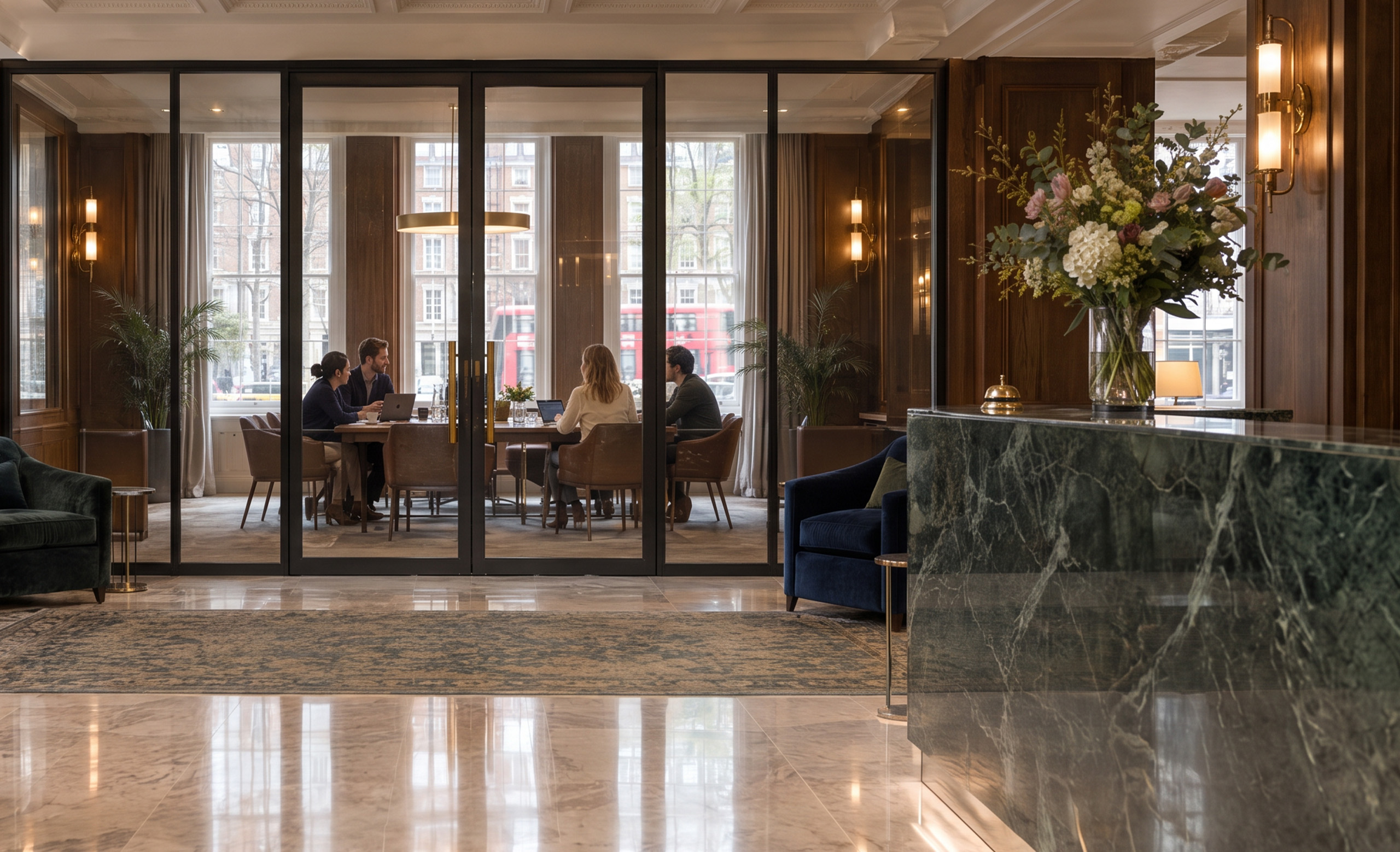
Most flexible workspace operators start with an office building and spend years learning to think like hoteliers. Arora Group is doing it the other way around. The British company is best known for its hotels around Heathrow, Gatwick and Stansted, and it has now launched its own flex brand, Arora Works. The first site is open in Hammersmith, West London, and a second will follow at Heathrow in early 2027.
On paper it is a modest launch of two locations in a city full of flex space. But it shows something bigger about where the market is heading. The line between hotels and offices is getting thinner, and the companies that already own the hospitality playbook are starting to use it.
What Arora Works offers
Arora Works has two products. The first is private flexible offices for teams of different sizes. The second is shared communal space for coworking, networking and hot-desking. The Hammersmith location spans three floors of a refurbished office building and targets professionals in technology, media and corporate services.
The Heathrow site is the more unusual one. It will sit in the World Business Centre near the airport, with runway views and a short trip to the check-in desks. Arora calls it “transit-aligned” workspace.
The group behind it is not a newcomer to real estate. Founder and chairman Surinder Arora started in 1993 with a B&B for airline crews at Heathrow. Today the group runs a portfolio worth more than €3.5 billion across property, hotels, leisure and construction. CEO Sanjay Arora describes Arora Works as a way to unlock the potential of that portfolio, with workspace built around hospitality principles.
Why hoteliers make natural flex operators
- Service is already the product. Flex operators have spent the past decade hiring hotel managers, adding concierge desks and talking about “hospitality-led” workspace. A hotel group already has all of this in place: front-of-house teams, housekeeping, food and beverage, event spaces and a service culture. For Arora, the hard part of flex is something it has done for thirty years.
- Yield thinking transfers well. Hoteliers sell space by the night and adjust prices to demand all the time. Selling desks by the day and offices by the month is a similar exercise. Revenue management skills can help squeeze more value out of meeting rooms and day passes, which are often the most underused assets in a flex centre.
- Owning real estate changes the risk profile. Many operators have been hurt by the mismatch between long leases and short member contracts. A group that controls its own buildings can absorb that risk more easily. This is the same owner-operator question we explored in our piece on The Social Hub’s asset-light shift, seen here from the opposite side.
- Transport hubs are an underserved niche. Regional teams, consultants and frequent flyers need somewhere professional to work and meet near airports and major stations. A hotelier with a strong airport presence is well placed to serve that demand.
The catch: hospitality is not the same as community
None of this guarantees success. A hotel guest stays for a night or two. A flex member may stay for months or years and expects more than clean rooms and good coffee. Coworking runs on community management, flexible contracts, member technology and a sales engine that can reach SMEs and enterprise teams. Those are different muscles from filling rooms through booking platforms.
Scale is also a question. Two locations is a small footprint, and recent industry analysis suggests smaller flex operations carry more financial risk than larger ones. Arora can share services across its wider group, which helps. But London’s flex market is crowded and competitive. Argyll, for example, has just grown its network to 26 sites.
Hotels, landlords, operators: everyone wants a seat at the desk
The bigger story is convergence. Hotels are adding workspaces, flex operators are adding hotel-style service, and landlords are launching their own flex brands. For occupiers this means more choice and a higher baseline for quality. That ties in with the push for clearer quality ratings in flexible workspace.
For hotel owners elsewhere, including in the Netherlands, Arora Works is a case worth watching. Many hotels near airports and major train stations have meeting rooms, lobbies and floors that sit quiet during the working day. Turning that capacity into flexible workspace could be a smart diversification, as long as owners treat it as a separate business with its own skills, and not as a side project for the reception desk.
Checking in for the long stay
Arora Works is a small launch with a clear signal: hospitality companies no longer just inspire flexible workspace, they are starting to compete in it. Whether hoteliers can turn short stays into long-term memberships will decide how far this trend goes.