International law firm Baker McKenzie has signed a lease for roughly 6,000 square metres in a new development on Amsterdam’s Zuidas, and the deal is a near-perfect illustration of where the Dutch office market is heading in 2026. The firm is trading a two-decade-old address for a building designed from the ground up around sustainability, wellbeing and collaboration, in a market where that combination is becoming the price of entry for premium tenants.
The new office, The Canyon, sits within The Harmony, a mixed-use development on the Beethovenstraat being built by developer Zadelhoff. Baker McKenzie will occupy the ground floor, the entire first through fourth floors, and part of the fifth. Construction is due to start in early 2027, with delivery targeted for 2029 and the move itself planned for April 2030.
Leaving Baker House after nearly two decades
Baker McKenzie Amsterdam has been based at Baker House on the Claude Debussylaan since 2006, and the firm has had a presence in the Netherlands for more than 50 years. Kim Tan, managing partner of Baker McKenzie Amsterdam, described the move as bittersweet but necessary: leaving a long-time home while investing in a workplace that better matches how the team actually works today. The new office will include an auditorium for both client meetings and internal events, updated building technology, and integrated greenery aimed at supporting staff wellbeing.
The choice followed what Zadelhoff describes as a competitive selection process, with The Harmony ultimately winning out on its architecture, spatial quality and long-term vision.
Sustainability as the deciding factor
The Canyon, designed by Powerhouse Company, is being developed with a target of BREEAM Excellent certification, one of the higher tiers in the sustainability rating system used across European commercial real estate. The building is designed for energy efficiency and material choices intended to reduce its environmental footprint, and forms the architectural centrepiece of The Harmony, a roughly 35,000 sqm scheme combining two buildings, The Canyon and The Coast, with offices, homes and amenities.
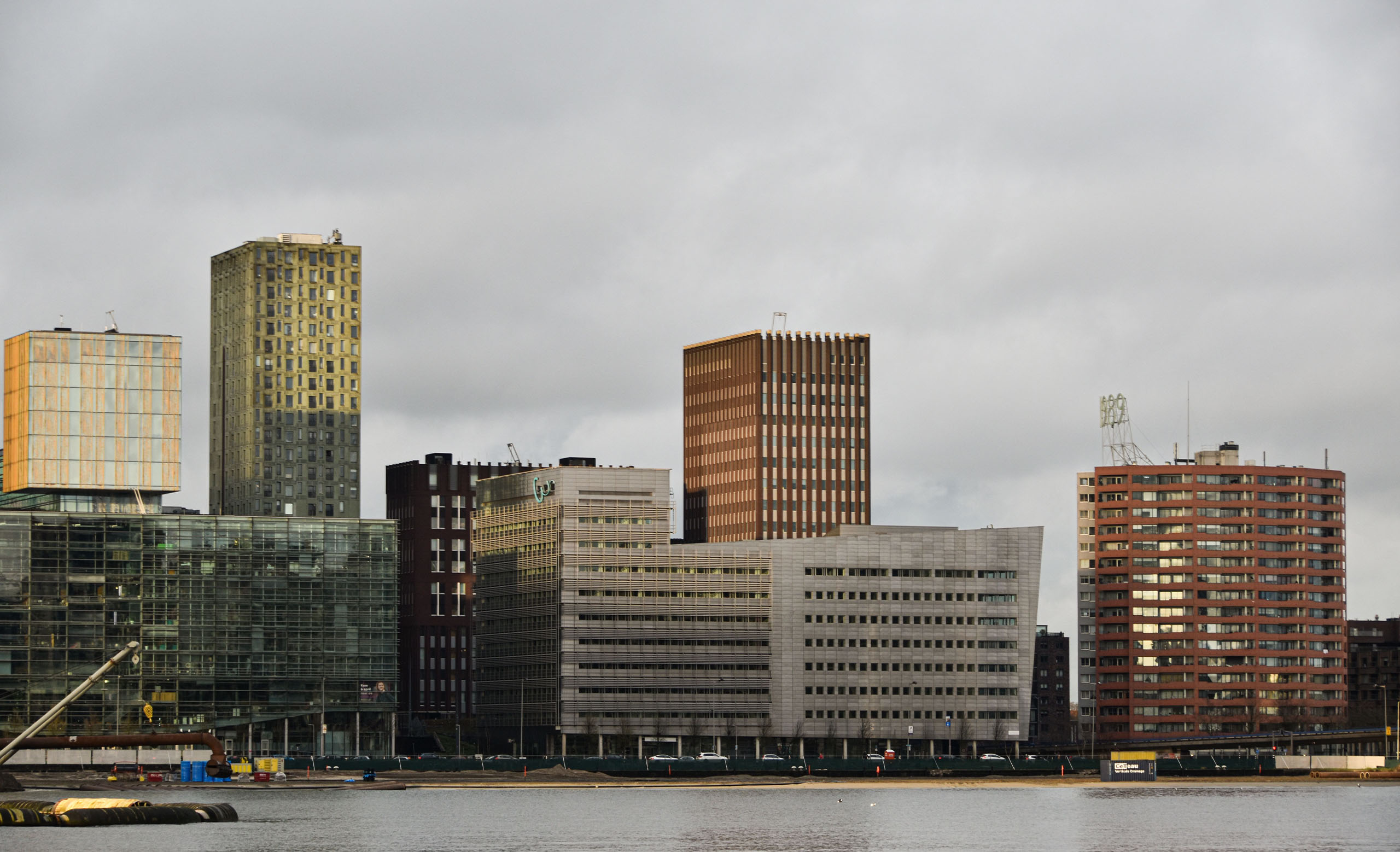
The development sits in the Ravel district, one of the newest parts of the Zuidas, designed with pedestrians and public space in mind and incorporating greenery from courtyards to façades and rooftops, developed in collaboration with a landscape architect and ecologist.
Part of a bigger pattern: Amsterdam’s bet on quality over quantity
The Baker McKenzie deal lands within the same year Amsterdam’s city council adopted a new Kantorenstrategie 2026, which formally dropped the long-standing target of adding 125,000 square metres of office space per year. In its place, the city is now steering development toward “the right workspace in the right location,” concentrating new office space on well-connected, high-quality sites while discouraging further office development in less accessible or lower-quality areas.
The reasoning lines up closely with what’s happening on the ground. According to figures from NVM Business, roughly 9.2% of the Dutch office stock was standing empty or available for rent or sale at the start of 2026, a number that on its face suggests plenty of slack in the market. But that headline figure obscures a sharper divide: there’s a genuine shortage of smaller, sustainable, high-quality office units in well-accessible locations, even as older and less accessible buildings struggle to find tenants at all. New office construction rose by 32% in 2025, yet that only lifted new-build’s share of the total stock from 2% to 3%, nowhere near enough to reshape the market on its own. JLL’s analysis goes further, noting that 55% of the office space due to hit the Dutch market in 2026 will be modernised or retrofitted existing buildings rather than genuinely new construction, a trend it expects to keep growing.
What it means for tenants and landlords
For occupiers like Baker McKenzie, the logic is increasingly straightforward: in a tight talent market, the office itself has become an HR tool, not just a cost line. Firms competing for the same graduate talent pool, and needing space that supports client meetings, collaboration and hybrid schedules, are among those driving the visible flight to quality on the Zuidas and in similar top locations such as Utrecht Centraal.
For landlords holding older, harder-to-reach office stock, the message from both the market and the municipality is less comfortable. Amsterdam’s strategy explicitly signals that office development in those areas won’t be supported going forward, adding pressure on owners to either retrofit existing buildings to a higher standard or consider other uses for them, a shift already visible in the sharp rise of modernised space entering the market.
Whether other international firms follow Baker McKenzie’s example over the coming years will be one of the clearer signals of how deep this quality divide runs. For now, the Zuidas keeps adding evidence that in the Dutch office market of 2026, location and sustainability credentials are doing as much work as square metres.